
Data transparency
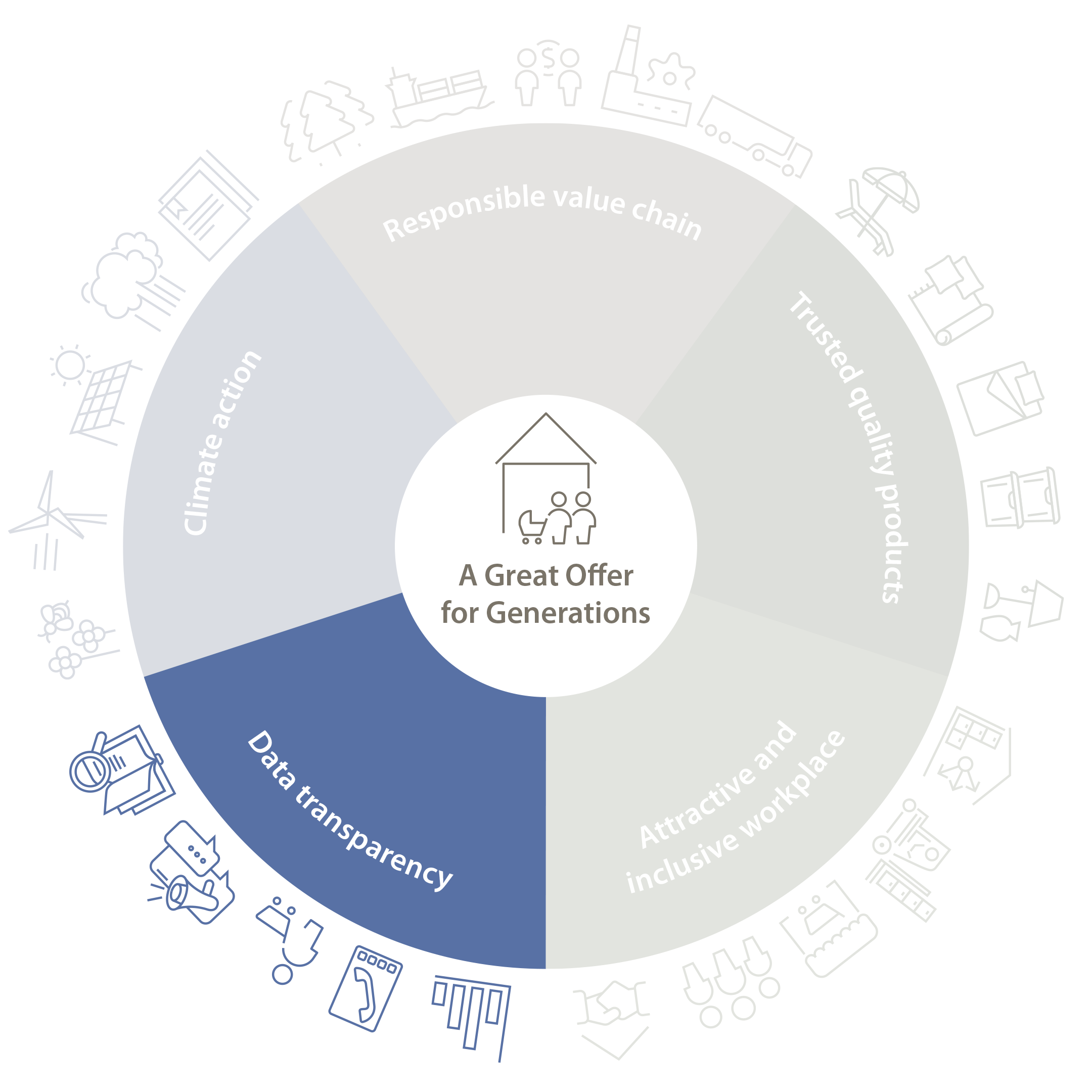
Our sustainability journey is ongoing, and we continuously work to improve our performance. We also comply with legislation across all our global operations. Historically, our primary focus has been on strengthening internal processes and ways of working, with less attention on external communication. Going forward, we will place an increased emphasis on transparency and communication, reflected both on our website and in our annual report, which includes our sustainability statement.
Our Double Materiality Assessment (DMA) helps define our priority areas. We acknowledge that there can be gaps in our data, but we are committed to addressing this over time to increase our data transparency in JYSK. Our goal is to provide clear and accessible updates about our sustainability work, enabling customers to make informed decisions by increasing their knowledge of how we approach and work with sustainability at JYSK.
In the following sections, we will explain more about:
- Double materiality assessment
- Sustainability reporting
- JYSK sustainability governance structure
Double materiality assessment
Our double materiality assessment (DMA) was most recently updated in 2026 to reflect our current context and the simplified European Sustainability Reporting Standards (ESRS).
The DMA evaluates our business from both inside-out and outside-in perspectives, identifying the areas that are most material to JYSK based on the negative and positive impacts, risks, and opportunities (IROs) we face.
Our actions within sustainability are aligned with the findings of our DMA, as we prioritise the most material topics.
As a large and growing international retailer, we recognise that we have a negative impact in certain areas, and the DMA process has been a method for JYSK to gain further insights into these areas. We therefore also see this as an opportunity to understand where we can mitigate impacts. Naturally, the DMA has provided the foundation for us to outline our sustainability strategy, A Great Offer for Generations.
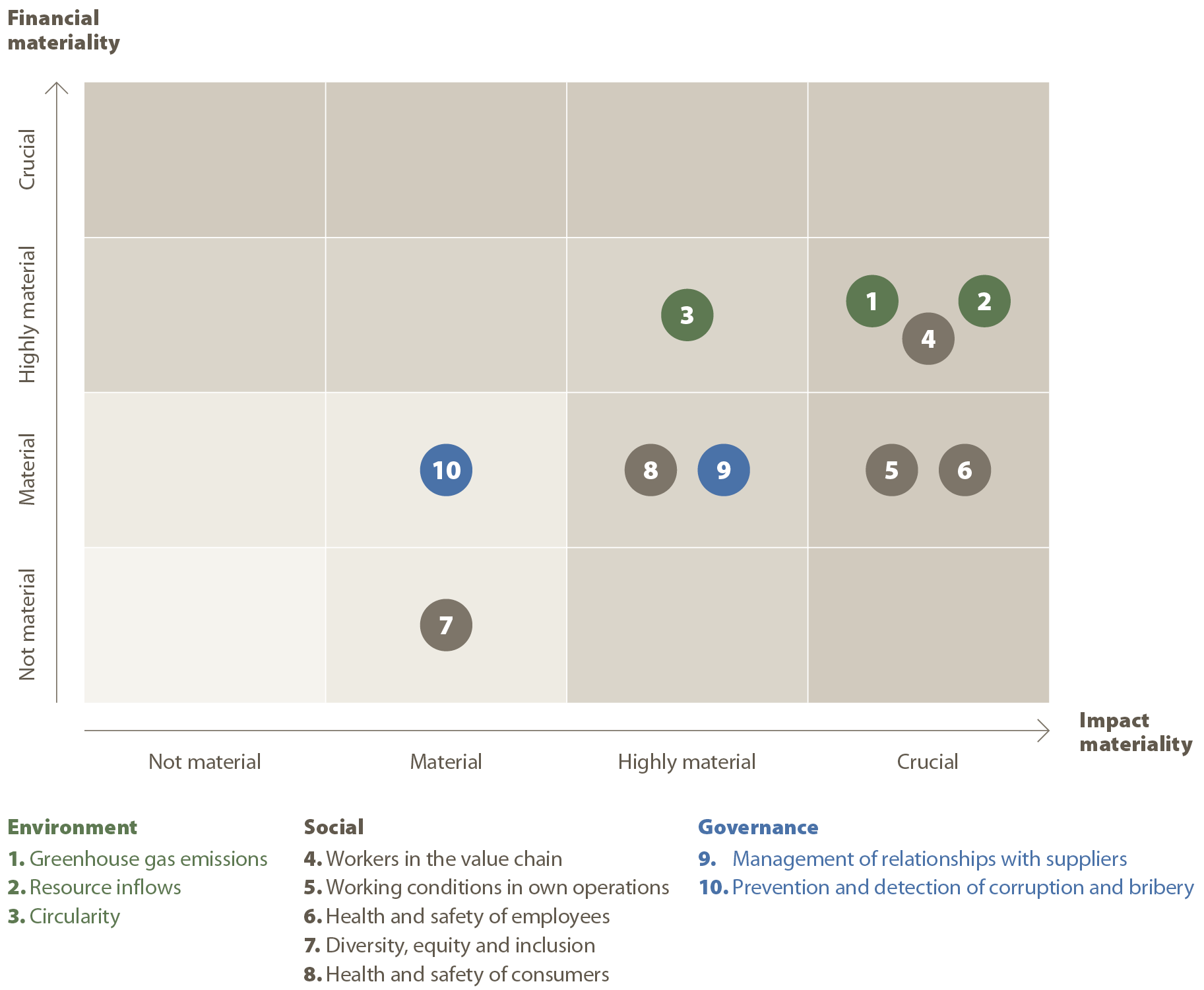
The DMA identified 10 areas, referred to as Sustainability Matters, covering Environmental, Social, and Governance (ESG) aspects within our operations and our value chain. These areas include:
Environment
1. Greenhouse Gas (GHG) Emissions
As a large and growing retailer, JYSK contributes to significant greenhouse gas emissions through the energy-intensive materials used in our products. Operating a large number of stores and distribution centres also requires a substantial amount of energy. Our science-based targets are an important part of our commitment to reducing our greenhouse gas emissions.
2. Resource inflows
We use a variety of materials in our products, and the farming, production, and processing of these materials have a negative environmental impact. For example, cotton farming requires significant amounts of water, while wood-based products are associated with biodiversity loss. JYSK is working with certifications such as FSC™ and memberships such as the Better Cotton Initiative (BCI) to mitigate some of these impacts.
3. Circularity
The world is rapidly developing in terms of circularity and minimising waste. This is also a focus area at JYSK, where we work with recycled contents on various materials, such as textiles, and we offer spare parts for selected products to enable repairs. We aim to increase circularity through initiatives that extend product life and support more circular material flows, through increased recyclability of our products.
Social
4. Workers in the value chain
JYSK has a responsibility for workers in our value chain, which includes areas such as working conditions, safety, and working hours. At JYSK, we take a risk-based approach to mitigating these challenges, where we, in risk countries, work with amfori BSCI. As a member of amfori BSCI, JYSK adheres to a common code of conduct with specific requirements regarding the working conditions in the factories where JYSK’s products are produced. amfori BSCI also performs audits at the manufacturers to follow up on the aspects described in the code of conduct
5. Working conditions in own operations
As a large employer, we prioritise the wellbeing of our employees, ensuring they feel safe, content, and valued at work. We take responsibility to ensure fair and decent working conditions for our employees, including wage adequacy, working time, work–life balance and employment security, as well as our extensive work with training and skill development.
6. Health and safety of employees
Work in stores and distribution centres involve physical demands and manual handling. We continuously work to prevent accidents and injuries by strengthening safety procedures, training employees, and improving workplace setups to continue ensuring safe and healthy working environment.
7. Diversity, Equity, and Inclusion (DEI)
We strive to ensure equal opportunities and an inclusive workplace where people are treated fairly. Our efforts within Diversity, Equity, and Inclusion include a focus on diversity in both recruitment and promotions.
8. Health and safety of consumers
The safety of our products is a key focus area for JYSK. We have a rigorous testing setup and clear safety standards, such as those concerning Substances of Very High Concern, which JYSK has chosen to exclude from our products.
Governance
9. Management of relationships with suppliers
As a retailer, JYSK has a potential impact on our supply chain, particularly through our ethical conduct towards suppliers. For product suppliers, we implement auditing schemes (amfori BEPI & amfori BSCI) and utilise these in our dialogue with suppliers. If a supplier receives a score that does not meet the requirements, we work with them to facilitate their improvement.
10. Prevention and detection of corruption and bribery
Operating across countries and functions can expose our business to corruption and bribery risks. We work to prevent, detect and respond to unethical practices and protect integrity in our operations and value chain. JYSK has a whistleblower service that is open to both internal and external cases.
Sustainability reporting
JYSK is required to comply with the Corporate Sustainability Reporting Directive (CSRD) starting in 2027 and do so through our parent company, Lars Larsen Group. In addition to this, we decided to initiate our own independent sustainability reporting, starting in FY25, through sustainability statements in our annual reports. We will continue to monitor the revision of the CSRD and ESRS to define the scope for future reporting on this basis.
Independent sustainability reporting represents a valuable opportunity for JYSK to further enhance our communication about our sustainability efforts as well as increase our data transparency.
As an international retailer operating in 29 countries, we recognise that not all countries are at the same level of maturity regarding sustainability. Our approach involves making decisions that apply across all our operations, which may represent small steps in some countries and larger strides in others.
Internally, we promote transparency by benchmarking our countries on various topics, including emissions, employee satisfaction, gender balance, and more. This helps us build a stronger foundation of transparency within JYSK.
Our sustainability governance structure
At JYSK, sustainability is integrated across various departments and levels, ensuring it is embedded in our operations. Each department focuses on specific sustainability initiatives tailored to their areas, and we systematically share knowledge among departments.
Our sustainability governance structure is divided into three levels:
- The Sustainability Management Group
- The Sustainability Team
- The ESG Core Groups
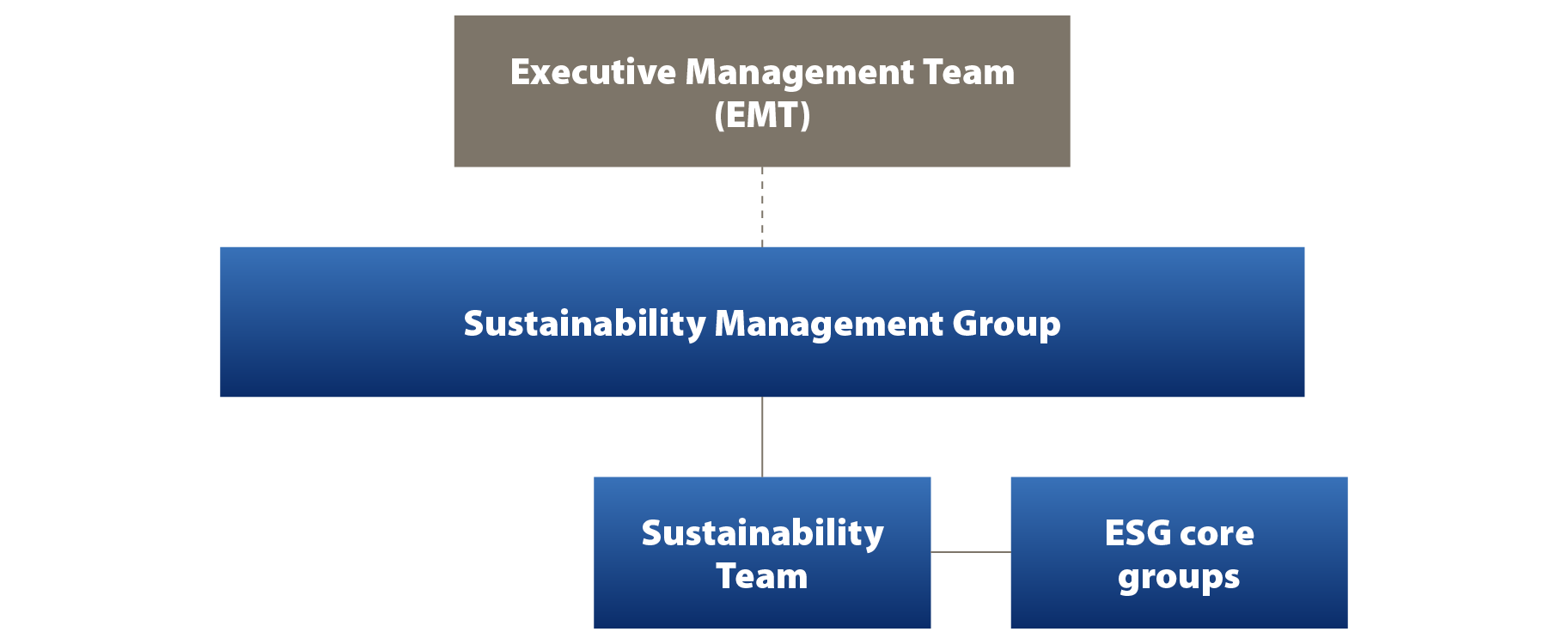
The Sustainability Management Group comprises the CEO, CFO, EVP of Purchasing, Sustainability Director, Compliance & Quality Director, and Communications Director. This group is responsible for setting the strategic direction and prioritising JYSK’s sustainability efforts, as well as discussing risks and resource allocation. The group reviews and approves any changes or adjustments proposed by the Sustainability Team and/or ESG Core Groups. It maintains a direct link to the Executive Management Team (EMT) to ensure alignment with the broader business strategy.
The Sustainability Team acts as the strategic umbrella, guiding JYSK’s sustainability journey through a wide range of initiatives. This team is responsible for defining the sustainability direction, tracking progress on initiatives, and ensuring coordination across departments. Additionally, the team regularly reviews the DMA to ensure it accurately reflects JYSK’s impacts, risks, and opportunities. This process ensures that our approach to sustainability remains relevant and aligned with our business goals. The Sustainability Director reports directly to the CFO.
The ESG Core Groups consist of two tracks: an Environmental track and a Social and Governance track. These groups include representatives from key departments, such as Sustainability, Purchasing, Logistics, Retail Development, Real Estate, HR, Communications, Marketing, and Country Management. These groups meet regularly to provide updates on their sustainability initiatives, report on progress, and align with JYSK's overall sustainability KPIs. The purpose of these meetings is to ensure that each area contributes its expertise and decision-making power, facilitate knowledge sharing, and agree on strategic sustainability priorities based on the impact and effort of each focus area.